KDP AI Disclosure: What to Declare in 5 Common Cases

KDP asks you to disclose AI-generated content: text, images or translations that an AI tool created. That includes cover art, and it includes material you edited heavily afterwards. AI-assisted work does not need disclosing. If you wrote the content yourself and used AI to edit, refine or error-check it, or used AI to brainstorm ideas that you then wrote up yourself, Amazon says it does not need to be told.
The hard part is applying those two definitions to a real book, where the manuscript, the cover and maybe a translation each have their own history. Below are five common cases, checked against the wording of Amazon's Content Guidelines. The video walks through the same five.
What KDP's AI question actually covers
Amazon's guidelines draw one line, between AI-generated and AI-assisted content. Here is the AI-generated definition in full:
We define AI-generated content as text, images, or translations created by an AI-based tool. If you used an AI-based tool to create the actual content (whether text, images, or translations), it is considered "AI-generated," even if you applied substantial edits afterwards.
And the AI-assisted one:
If you created the content yourself, and used AI-based tools to edit, refine, error-check, or otherwise improve that content (whether text or images), then it is considered "AI-assisted" and not "AI-generated." Similarly, if you used an AI-based tool to brainstorm and generate ideas, but ultimately created the text or images yourself, this is also considered "AI-assisted" and not "AI-generated." It is not necessary to inform us of the use of such tools or processes.
Three more details from the same page matter here:
The question comes up when you publish a new book or edit and republish an existing one through KDP.
AI-generated images "include cover and interior images and artwork."
Whichever category your content falls into, you are still responsible for making sure it meets the rest of KDP's content guidelines.
The test in every case below is the same: who created the content that ends up in the book, and what did the tool actually do?
Case 1: You edited text that an AI wrote
You ask an AI tool to write a scene. Then you rewrite the dialogue, cut a character and spend an afternoon fixing the ending.
That scene is still AI-generated under KDP's definition. The tool created the actual content, and the definition says substantial edits afterwards do not change that. There is no point trying to work out whether you changed 50% or 80% of it. The guidelines give no editing percentage, so no amount of rewriting turns generated text into assisted text.
This holds even if the scene is one small part of a long manuscript that you otherwise wrote yourself. Keep a note of which sections started as generated text, so you can answer accurately when you upload.
Case 2: An AI tool edited text you wrote
Now reverse it. You wrote the scene, and a tool flags a spelling mistake, fixes punctuation or suggests a smoother sentence. Amazon describes that kind of improvement to your own work as AI-assisted, and it does not need disclosing.
This is why the name of the app does not settle the question. Two authors can open the same writing tool and do very different things with it: one asks it to check a paragraph they wrote, the other asks it to write the next paragraph. Look at the task you gave the tool and what you actually used from it.
You ask where your argument is unclear, then write your own explanation. That is assisted.
You ask the tool to supply a missing section and paste that section into the book. That section is generated, and it needs disclosing even if you wrote everything around it.
Case 3: Brainstorming, and when your notes become the tool's prose
Using AI for ideas sits in Amazon's assisted category. Asking for possible conflicts in a mystery, picking one and writing the scene yourself, or talking through chapter topics and then writing the chapters: all of that is AI-assisted.
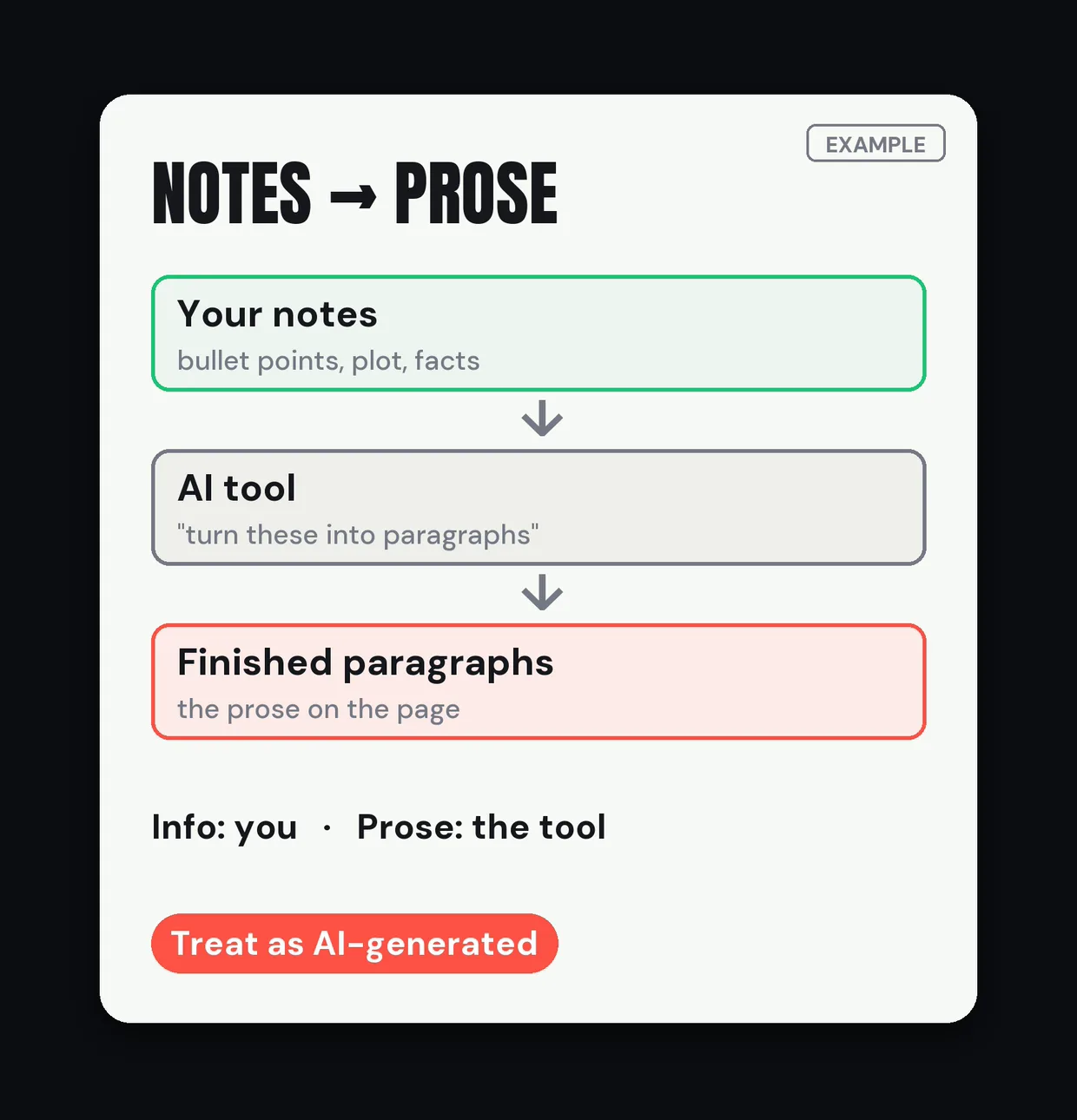
Handing over your notes and asking the tool to turn them into finished paragraphs is different. You supplied the information, but the tool supplied the prose. Applying Amazon's definition, we would treat those paragraphs as AI-generated. Having the original idea does not tell you who created the text that ended up on the page.
Case 4: An AI-generated cover
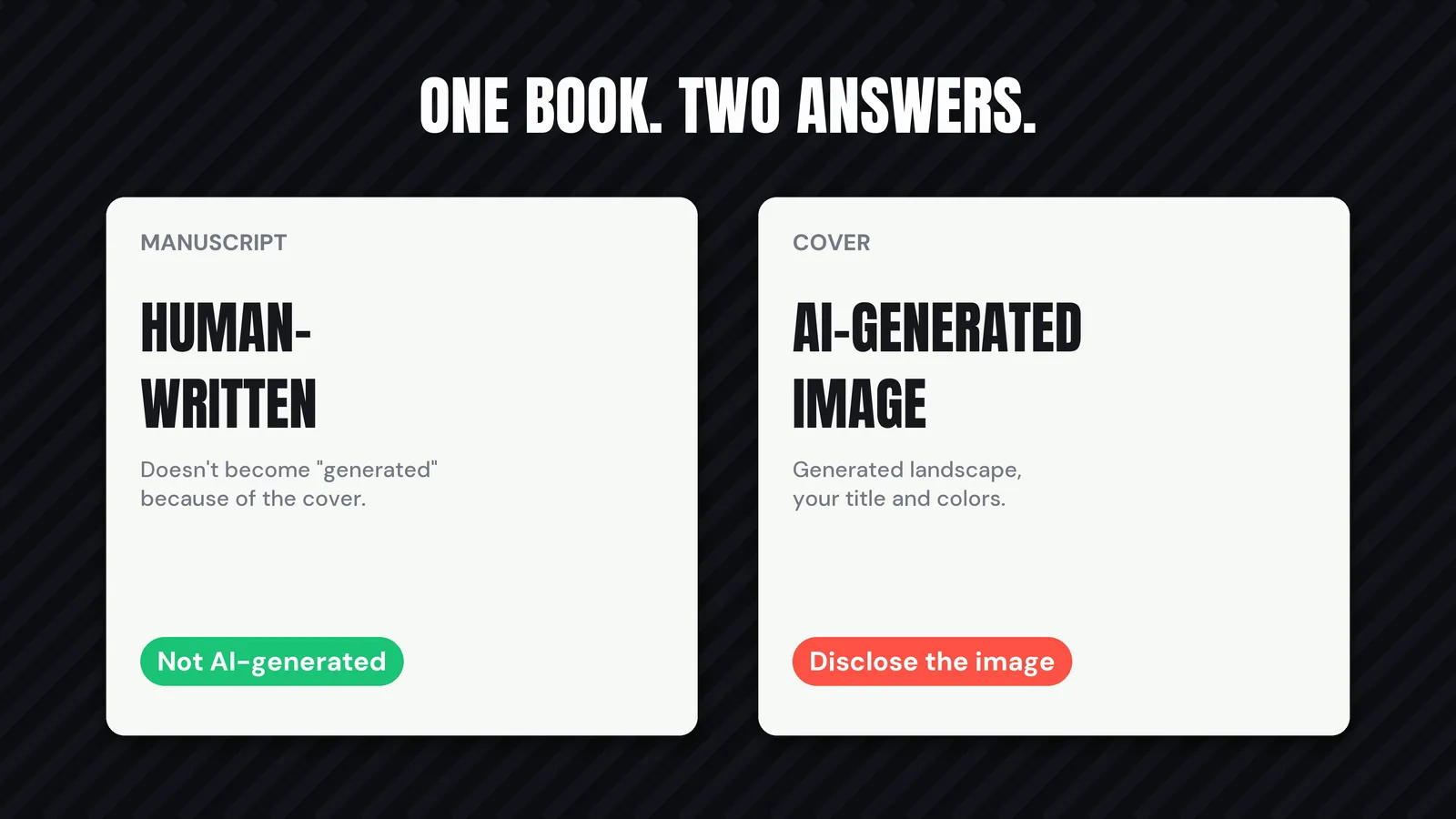
The cover is the case authors most often overlook, usually because they never used AI on the manuscript. Say you generated a landscape with an AI tool, added your title, changed the colors and used it on the cover. Amazon's guidelines say AI-generated images include cover and interior images and artwork, so that image needs disclosing.
It does not change how you describe the manuscript. A human-written manuscript does not become generated text because the cover contains a generated image. Answer for each part separately.
If a designer made your cover
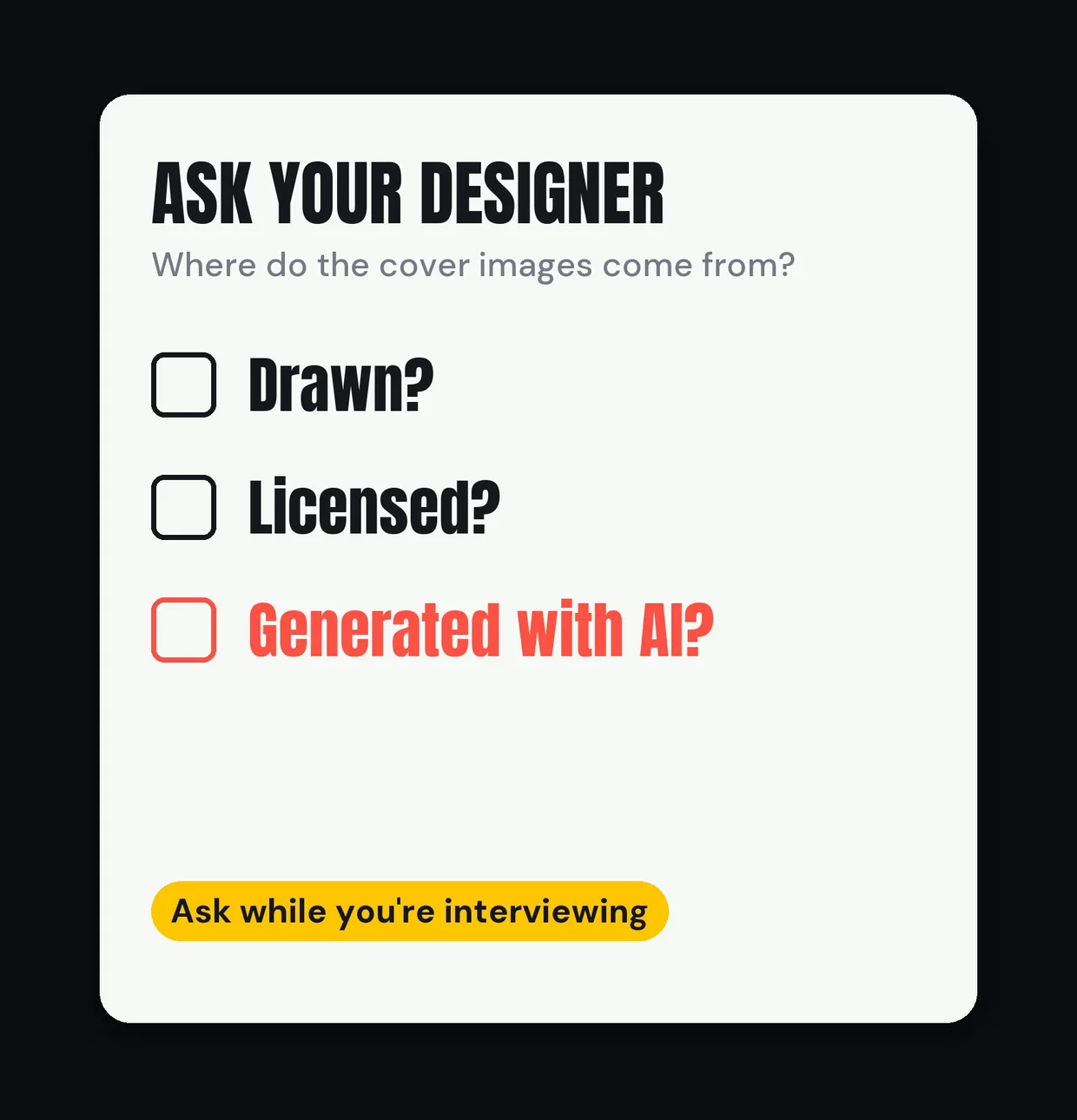
Paying someone to assemble a cover does not tell you how every image in it was created. Ask while you are choosing a designer: are the images drawn, licensed or generated with AI? Their answer decides how you answer KDP.
Editing a photo versus generating something new
Ordinary cleanup of a photograph you took, such as cropping it or adjusting the color, is a different workflow from generating a brand-new background with an AI tool. The first starts with your own image and improves it, which matches Amazon's description of assisted work. The second creates new image content, which is generated.
Many image editors now mix both kinds of feature, and the public guidelines do not rule on individual tools. Look at the specific operation you used and where the resulting image came from. If your case is still unclear, give KDP support a concrete description of what was created and what was edited rather than guessing.
Case 5: Translating your book with an AI tool
Suppose you use a third-party AI tool to translate your English manuscript into Spanish, then hire a translator to polish the result. The translation started as AI-generated content, and the definition names translations explicitly. Human editing afterwards does not remove the disclosure, for the same reason as in case 1.
This case is about third-party tools. Amazon's own Kindle Translate service is a separate program with its own help pages, and it is not covered here.
Before you upload: a quick inventory
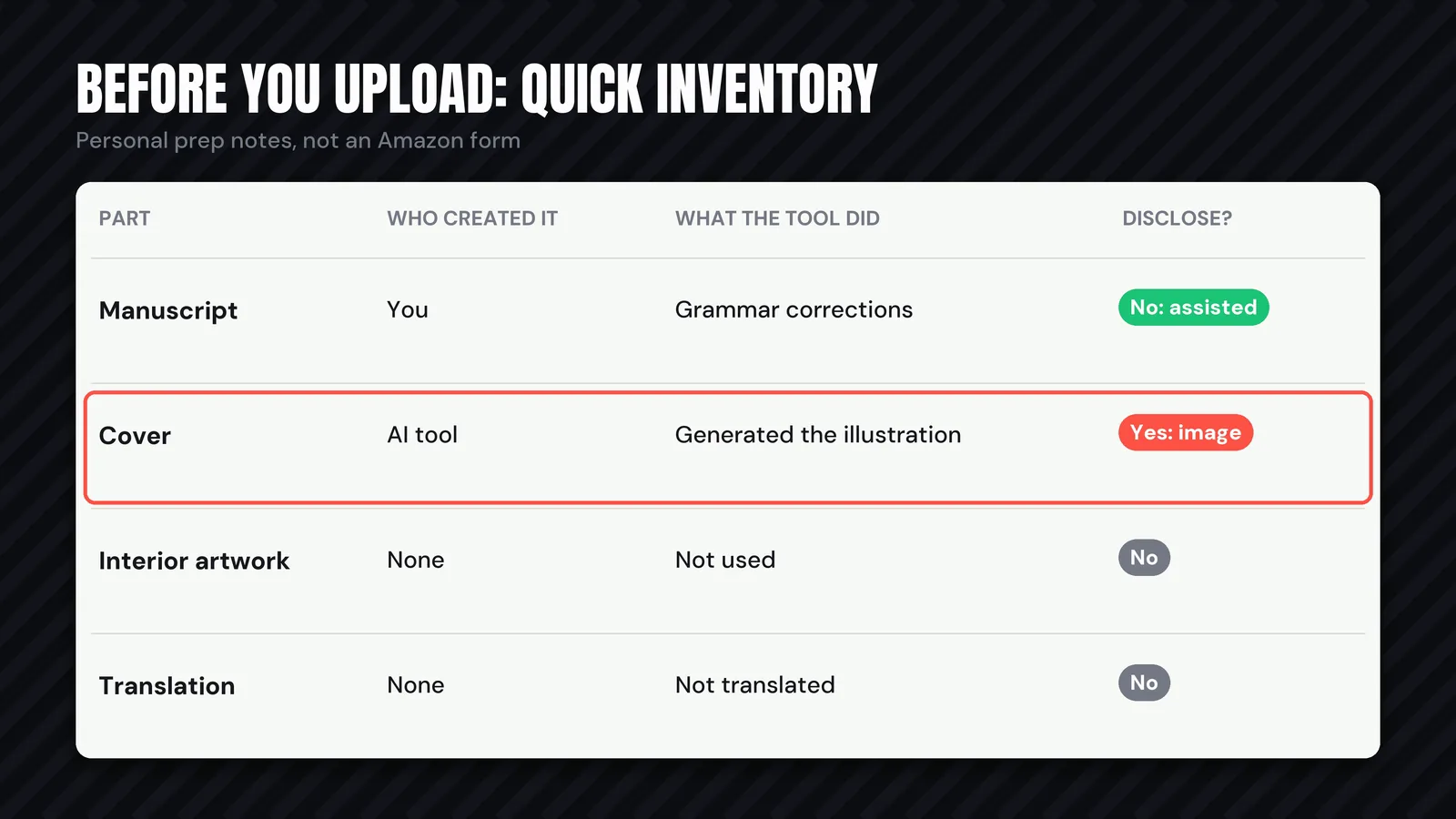
Most mistakes here come from thinking about one part of the book and forgetting another. Before you upload, list each part and note who created it and what any tool did:
Manuscript
Cover
Interior artwork
Translation
These are your own prep notes, not an Amazon form. A few lines are enough.
Here is a worked example. You wrote the manuscript and used AI for grammar corrections. The cover illustration was generated. There is no interior artwork and no translation. The only thing to disclose is the generated cover image. The grammar help does not make the manuscript generated text.
To fill one in for your own book, download the one-page worksheet. It has the inventory table, quick checks for the cases above, questions for your cover designer and KDP's definitions in their own words.
Prefer a spreadsheet? Download the Excel version, which fills in the Disclose column from your answers. Duplicate the sheet for each book.
Answer based on what actually happened. You do not need to label your own writing as generated just to be cautious, and you should not leave generated material out because you worked hard on the edits that came after it.
With the disclosure settled, the rest of the upload is your listing. The KDP launch day checklist walks through the full sequence, and the free KDP Category Finder gives you a category shortlist to check against your book.
What the guidelines do not say
Plenty of pages about KDP's AI rules state things that Amazon's guidelines do not. Here is what the official page leaves out, so you can weigh those claims accordingly:
No editing threshold. Nothing in the definition sets a percentage of rewriting that turns generated content into assisted content.
Nothing about what happens to your answers. The page does not say how Amazon uses the disclosure, whether it is shown to readers, or whether it affects how a book ranks or sells. Claims in either direction are not coming from the guidelines.
No tool-by-tool rulings. The definitions describe what a tool did, not which tools count.
Policies change, so read the current guidelines before you publish. For the wider business risk of building a catalog on AI content, see our piece on mass-producing AI books on KDP.
FAQ
Do you have to disclose if a book is written by AI?
Yes. KDP asks you to disclose AI-generated text, images and translations when you publish a new book or edit and republish an existing one. That includes text an AI wrote that you later edited.
Is AI allowed on Amazon KDP?
KDP's content guidelines set rules for AI content rather than banning it. AI-generated content must be disclosed, and all content, whether AI-assisted or AI-generated, must meet the rest of the guidelines.
What is the difference between AI-generated and AI-assisted?
AI-generated means an AI tool created the content itself, whether text, images or a translation, even if you edited it afterwards. AI-assisted means you created the content and used AI to edit, refine or error-check it, or to brainstorm ideas you then wrote up yourself. Only AI-generated content needs disclosing.
Do I need to disclose using AI for grammar or spelling?
No. Using AI to correct or refine writing you created yourself is AI-assisted under KDP's definition, and Amazon says it does not need to be told.
I wrote the book but the cover is AI. Do I disclose?
Yes, disclose the cover image. KDP's guidelines say AI-generated images include cover and interior images and artwork. Your manuscript stays human-written, so you do not need to describe the text as generated.
Do I need to disclose AI on a book that is already published?
KDP asks for the disclosure when you publish a new book or edit and republish an existing one. If you republish a title that contains AI-generated content, answer accurately at that point.
Can Amazon tell if a book is AI-generated?
Amazon has not published how it reviews books for AI content. We look at what is publicly known about AI detection and books in Can Amazon Detect AI in Your Book? on our YouTube channel.
More in KDP
The Self-Published Author’s KDP Launch Day Checklist (2026)
The complete KDP launch checklist, drawn from real self-published author launch reports. 81 steps across 7 phases, interactive progress tracking, and a free printable PDF.
6 min readReadHow to Set Up Amazon A+ Content for Your Book in Just a Few Minutes
Learn how to add Amazon A+ Content to your KDP listings — including comparison tables and image modules — and where to find a free tool that cuts the setup time significantly.
4 min readReadAmazon KDP Upload Limit: 2 Titles Per Format Each Week
KDP allows 2 new title creations and 2 first submissions per format each week. Both limits reset Sunday at midnight UTC, and saved drafts still count when submitted.
3 min readRead