Can Amazon Detect AI in Your Book? What KDP Actually Checks
Amazon has not said it runs an AI detector on books published through KDP. What KDP has is a question: when you publish a new book or republish one, you tell Amazon whether it contains AI-generated text, images or translations, and you stay responsible for the content either way. Pages claiming Amazon sweeps its catalog with detection software are easy to find, but none we followed back leads to anything Amazon has published.
That does not make AI use invisible. Readers paste chapters into free detectors, some AI companies now watermark the text their models write, and researchers have scanned thousands of Kindle books. Each of those has real limits. Below is what each one can and cannot tell you, including a test we ran ourselves. The video covers the same ground.
What Amazon has said, and what it has not
Amazon's Content Guidelines ask you to disclose AI-generated text, images and translations when you publish a new book or edit and republish an existing one. AI-assisted work does not need disclosing: that covers editing, refining or error-checking writing you created yourself, and brainstorming ideas you then wrote up yourself. For how those definitions apply to real books, including covers and translations, see our guide to KDP AI disclosure.
What the guidelines do not describe is detection. The page does not say Amazon scans manuscripts for AI text, how it uses your disclosure answers, or whether readers ever see them.
You will find pages saying Amazon runs detection sweeps, or that enforcement tightened on a particular date. When we followed those claims back, none led to an Amazon statement. Treat them as unverified until Amazon publishes something.
So the straight answer to "can Amazon detect AI writing?" is that Amazon has not said whether it can or does. The public parts are the disclosure question and the responsibility that comes with it.
How AI detectors work, and why they misfire
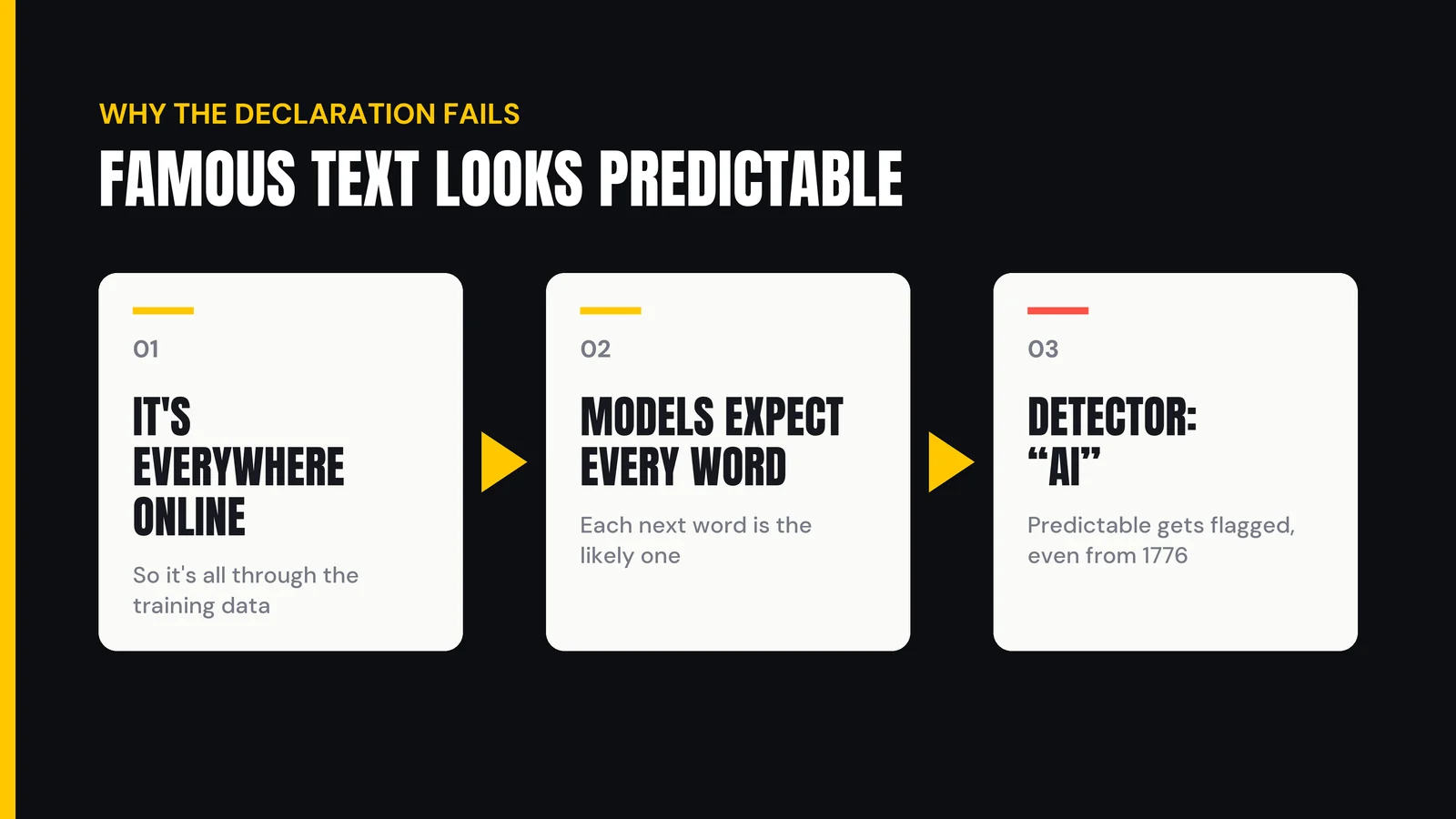
Tools like GPTZero, ZeroGPT, Originality and Pangram cannot see who wrote a passage. They estimate how predictable the text is. Language models write by choosing likely next words, so text in which every word is the likely choice reads as machine-made.
That is why famous, formal writing causes trouble. A document quoted all over the internet sits in the data these models learned from, so it looks highly predictable. In a widely reported test, ZeroGPT scored the Declaration of Independence 97.93% AI.
The misfires are not limited to old documents:
OpenAI released its own AI text classifier in January 2023 and withdrew it that July, citing its "low rate of accuracy." In OpenAI's own evaluation, it identified 26% of AI-written text as likely AI and wrongly labeled human writing as AI 9% of the time.
Stanford researchers found that detectors "consistently misclassify non-native English writing samples as AI-generated." Plainer, more constrained phrasing looks predictable too.
We ran the same test ourselves
On October 21, 2026, we pasted two texts into the free web versions of four detectors, not logged in and on default settings. One was the Declaration of Independence, using the National Archives transcription. The other was the transcript of the video above, which was spoken on camera from an outline.
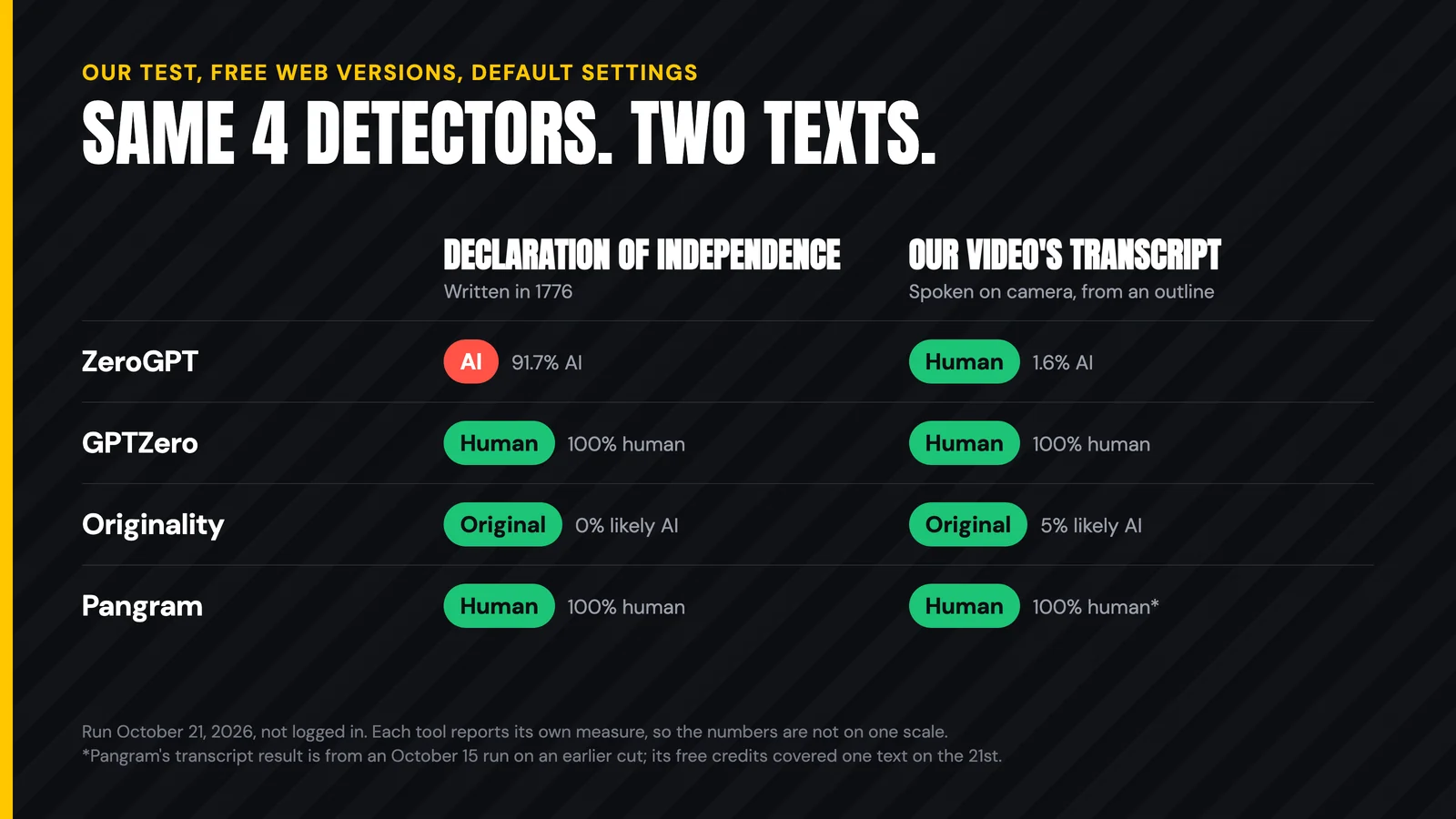
ZeroGPT still called the Declaration AI-generated, at 91.7%. GPTZero, Originality and Pangram all scored it as human. All four scored our transcript as human. Pangram's free credits covered only one text that day, so its transcript result comes from an earlier run on October 15, on a slightly longer cut of the same video.
What this shows is that the same document can be "AI" to one tool and "human" to the next. Detector makers update their models, and three of the four now score the Declaration as human. What it does not show is how accurate any of these tools are in general. Two texts, run once each, cannot tell you that.
The practical point: a detector score is one tool's estimate on one day. If a reader posts a score about your book, it is not evidence of how the book was written. If you run your own manuscript through a detector, do not treat a high score as a verdict, and do not treat a low one as proof either.
What a study of 14,419 Kindle books found
Detection at scale has improved. In a 2026 working paper, Chakrabarty and colleagues used Pangram, one of the newer detectors, on 14,419 self-published genre-fiction e-books sold on Amazon and released between January 2023 and March 2026.
20% had substantial AI text, meaning the detector judged more than a quarter of the book to be AI-written. Those books accounted for 12.1% of the sample's sales.
Another 17.1% had a lighter share, up to a quarter of the book.
The paper reports a false-positive rate of 0.04% from held-out evaluation. It does not describe how those human-written test texts were chosen.
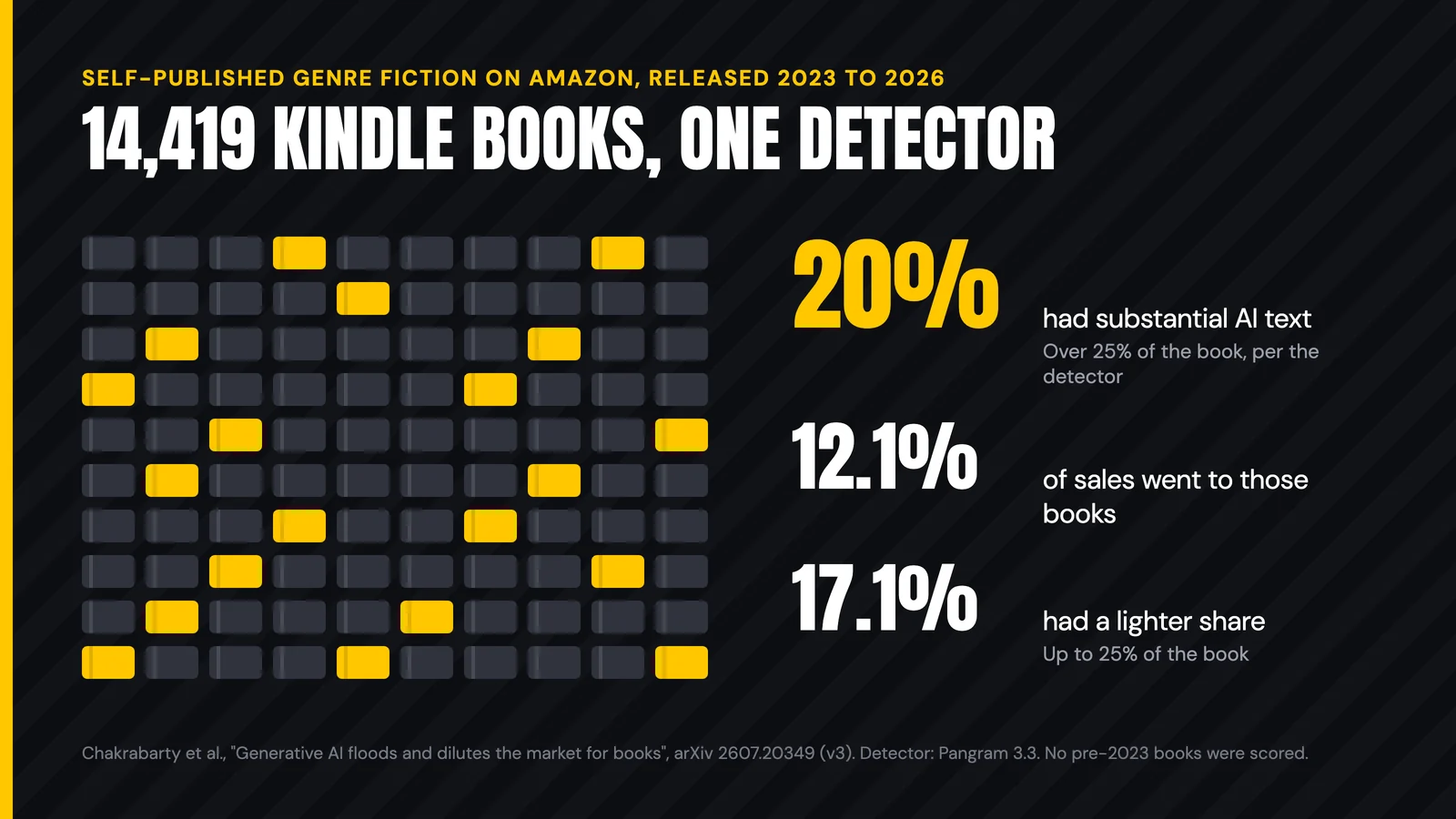
What the study leaves out is a baseline. No books from before 2023 were scored. Running the same detector on genre fiction published before ChatGPT existed would show how often it flags books that cannot contain AI text. Without that, read the 20% as the detector's estimate for this sample, not a count of AI books on Amazon.
AI watermarks: what they can and cannot show
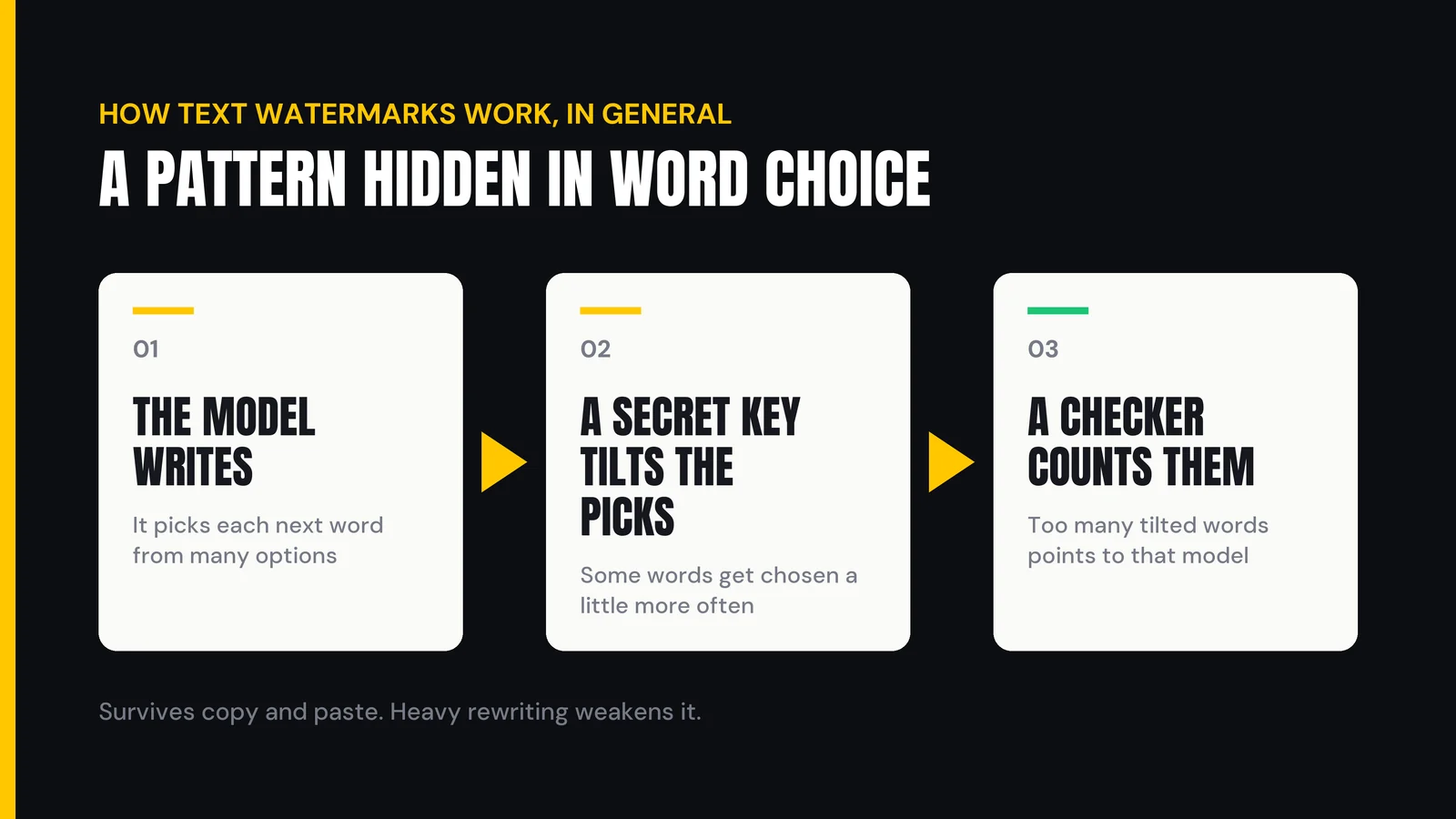
A text watermark is a pattern a company builds into its own model's output. As the model picks each word, a secret key nudges some choices slightly, and a checker that holds the key can count them later. You cannot see the pattern by reading the text.
Three companies matter most here, and much of the recent movement comes from the EU AI Act's transparency rules:
Google has watermarked text from the Gemini app and web experience with SynthID since May 2024, and has open-sourced the text method for other developers. Google says the mark holds up to light edits but weakens when text is thoroughly rewritten or translated.
Anthropic watermarks text from its newer Claude models and says it is adding the mark to older ones. The mark travels with copied text and may survive some editing. Detection is in private preview for organizations such as regulators, researchers and media outlets, so authors and readers cannot check Claude text themselves.
OpenAI announced in October 2026 that it is adding a watermark to eligible ChatGPT and Codex text in the European Union, with an opt-in for developers using its API. Its detector is open at first only to approved researchers and expert organizations. OpenAI's own numbers show how fragile these marks are: replacing 10% of the words in a passage with synonyms cut detection from about 92% to 66%.
Even where a watermark exists, it answers a narrow question. Anthropic's own help page says a detected mark shows Claude processed the content but is "not fully conclusive": Claude may not have written the original, and the text may have changed since. A watermark cannot tell "wrote this" from "edited this." That matters for authors, because KDP treats using AI to edit your own writing as assisted, not generated, and a watermark check cannot see the difference.
Why a missing watermark proves nothing
Open-weight models, such as Qwen, DeepSeek and Moonshot's Kimi, can be downloaded and run on your own computer or a rented server. Whoever runs the model controls how it writes, so there is no company in the middle to add a mark, and we have not found a major open-weight model that ships a text watermark. Even if a lab built one in, retraining the model afterwards could fade it.
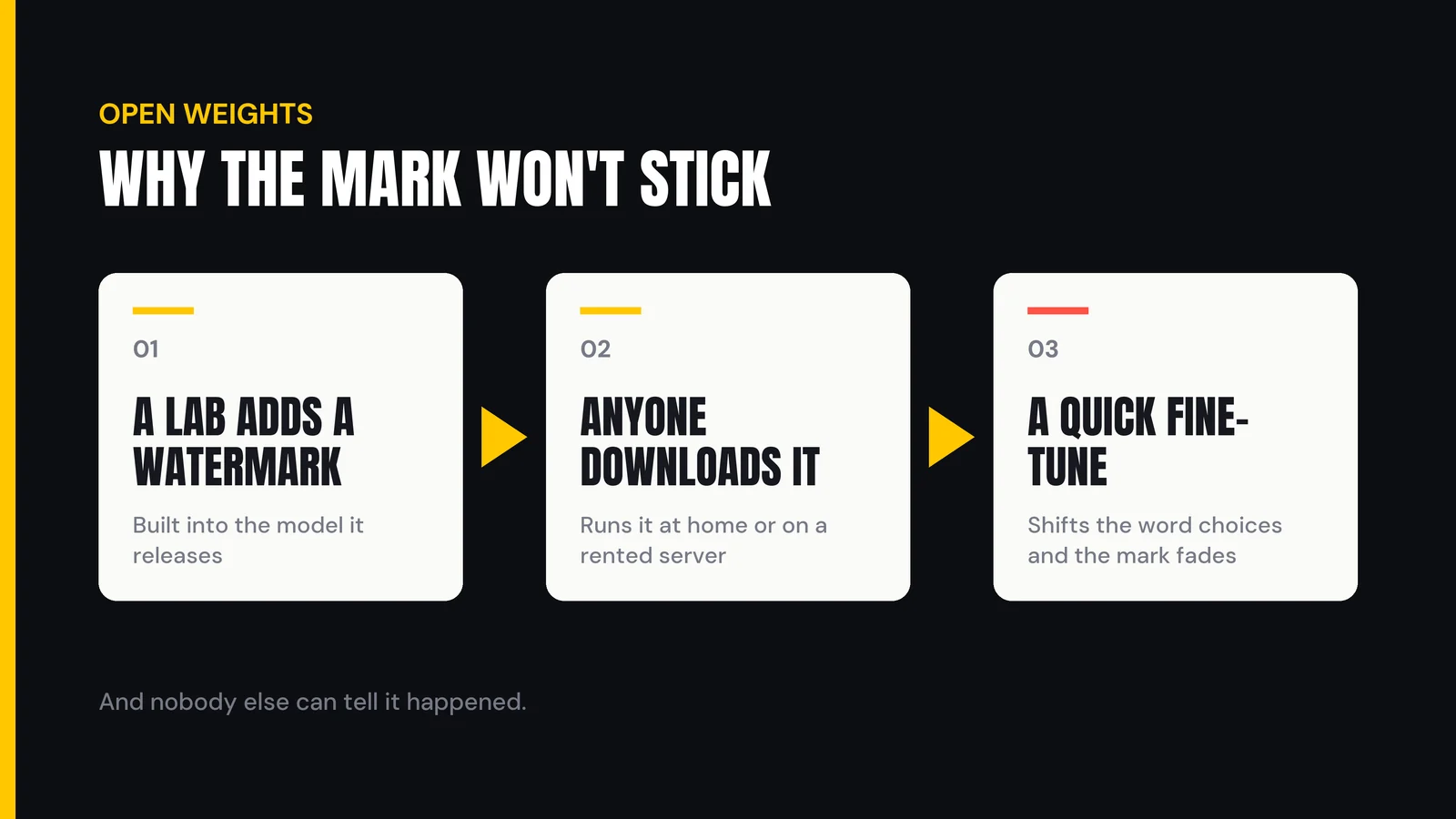
Anthropic's help page makes the same point from the other side: missing marks do not prove content was not AI-generated. So a watermark that is present is evidence that a particular model handled the text, and a watermark that is absent tells you nothing either way. That cuts both ways. It protects honest authors from "no watermark, so you must have hidden it," and it means a clean check is no proof of a human author.
How authors actually get caught
The public cases so far were found by readers, not software. In May 2025, readers found what looked like leftover AI editing notes in published novels by K.C. Crowne and Lena McDonald, and excerpts spread across Reddit, Goodreads and Bluesky, as Fast Company reported. One passage in McDonald's book read "I've rewritten the passage to align more with J. Bree's style," naming another author.
Other things readers notice:
Chapters built on the same template, making the same points in the same order
Repetition that an editing pass would have caught
Prose with the same rhythm and stock phrases from start to finish
Some readers also treat ordinary habits, such as em dashes, as proof of AI. They are not, and you cannot control what a reviewer decides to post. You can control the book. If you use AI anywhere in your process, read every page as a reader would, cut the repetition, and remove anything the tool was saying to you rather than to the reader. For the wider business risk of building a catalog on AI text, see our piece on mass-producing AI books on KDP.
What could change
This section is our prediction, not Amazon policy.
Platform-wide detection already exists elsewhere. Since July 2026, Substack has let readers scan posts, notes and comments with Pangram and see an estimate of how much was written by a human and how much by AI, TechCrunch reported. Writers can add a note about their process, check drafts before publishing, and report scans they believe are wrong.
Amazon already collects the answers. Every new and republished KDP book goes through the AI disclosure question. We would not be surprised if Amazon eventually combined those answers with data it already holds, such as returns, reviews and ratings, trained its own detection on them, or showed shoppers some kind of AI label. None of that has been announced.
Watermark checks will probably get easier to run as AI companies widen access to their detection tools. They will still say nothing about text from open-weight models.
Build a paper trail
Whether you write every word yourself or use AI along the way, a record of how the book was made is your strongest answer to an accusation. It also helps if you ever discuss the manuscript with a traditional publisher. Keep:
Version history in your writing app, so your drafts show the book taking shape over time
Dated notes, outlines and brainstorming documents
Research sources, and anything you quoted
A short record of what each AI tool did, if you used one
Emails and invoices from editors, cover designers and translators
A detector score posted in a review is one tool's estimate. A version history that shows the book changing over months is much harder to argue with.
Preparing a book for upload? Our KDP AI disclosure guide works through five common cases and includes a free one-page worksheet for recording who made each part of your book.
When the disclosure is settled, the rest of the upload is covered in our KDP launch day checklist.
FAQ
Can Amazon detect AI writing?
Amazon has not said it runs AI detection on books published through KDP, and it has not published how it reviews books for AI content. What KDP does is ask you to disclose AI-generated text, images and translations when you publish or republish a book.
Does KDP use an AI detector?
Nothing Amazon has published says it does. Pages claiming KDP runs detection sweeps do not cite an Amazon source. The disclosure question is the only AI-specific step in Amazon's public guidelines.
Can an AI detector flag a book I wrote myself?
Yes. Detectors measure how predictable text is, not who wrote it, so formal or familiar writing can score as AI. In our test, ZeroGPT scored the Declaration of Independence 91.7% AI while three other detectors called it human.
Is text from ChatGPT, Claude or Gemini watermarked?
Gemini text has carried Google's SynthID watermark since 2024, and Anthropic watermarks text from its newer Claude models. OpenAI is adding a watermark to ChatGPT text in the European Union. Detection for Claude and ChatGPT text is limited to approved organizations for now, so authors and readers cannot run the check themselves.
Does a missing watermark prove a book is human-written?
No. Open-weight models that people run themselves carry no watermark, and heavy rewriting weakens the marks that do exist. A missing watermark tells you nothing either way.
How many books on Amazon are AI-generated?
Nobody outside Amazon knows for the whole store. One 2026 study of 14,419 self-published genre-fiction e-books found that 20% had substantial AI text by one detector's estimate, with no books from before 2023 scored for comparison.
How can I prove I wrote my book?
Keep version history, dated notes and outlines, research sources and records from anyone who worked on the book. That trail is stronger evidence than any detector score, in either direction.
Do I have to tell Amazon I used AI?
Only for AI-generated content: text, images or translations an AI tool created, even if you edited them afterwards. Using AI to edit your own writing or to brainstorm ideas is AI-assisted and does not need disclosing. Our KDP AI disclosure guide works through five common cases.
More in KDP
The Self-Published Author’s KDP Launch Day Checklist (2026)
The complete KDP launch checklist, drawn from real self-published author launch reports. 81 steps across 7 phases, interactive progress tracking, and a free printable PDF.
6 min readReadHow to Set Up Amazon A+ Content for Your Book in Just a Few Minutes
Learn how to add Amazon A+ Content to your KDP listings — including comparison tables and image modules — and where to find a free tool that cuts the setup time significantly.
4 min readReadAmazon KDP Upload Limit: 2 Titles Per Format Each Week
KDP allows 2 new title creations and 2 first submissions per format each week. Both limits reset Sunday at midnight UTC, and saved drafts still count when submitted.
3 min readRead