Underserved Kindle Genres: What Readers Buy vs What Authors Publish

We compared what readers buy with how many new books arrive across about 400 Kindle fiction categories, using data pulled from the Amazon US Kindle store on October 17, 2026. Three genres looked genuinely open: mafia romance, kidnapping crime fiction, and a run of "marriage in crisis" books inside marriage and divorce fiction. Two genres that keep getting called underserved, horror and clean and wholesome romance, turned out to be crowded. Domestic thrillers had the best numbers of all, but one author holds the top. Every sales figure here is an estimate from sales rank, and ranks move daily, so treat this as a dated snapshot and a method you can rerun.
Why agent wish lists do not answer this question
The usual "underserved genre" lists come from the traditional side. QueryTracker, a site writers use to find literary agents and track submissions, publishes which genres agents request most and which genres its writers query most. Those lists are real, and the gap between them is interesting. But an agent's wish list measures what agents want to read in submissions, not what readers buy, and if you self-publish, readers are the only market that counts.
So we asked the same question on Amazon itself.
How we measured demand, supply and openness
We used three numbers for every category.
Demand: what the #50 book sells. Amazon does not publish sales, but it publishes Best Sellers Rank. We took the book at #50 in each category, a spot a newer author can realistically reach, and converted its rank into estimated daily sales with our Book Sales Calculator. Not #1: the #1 book tells you about one book, often a superstar. The #50 book tells you about the category.
Supply: new English books in the last 90 days. Amazon's own search has a "Last 90 days" new-release filter and a language filter, so anyone can check the count. The language filter matters because the US store is full of other languages. German fiction alone had almost 40,000 new books in 90 days.
Openness: who holds the top. For the top books we looked at publication dates, publishers and authors. If the top of a category is all ten-year-old classics, or all one author, readers there are not really shopping for someone new.
To get there, we mapped about 400 Kindle fiction categories, screened them with our own database of about 13,000 Kindle book listings, picked the 19 most promising, and looked up 371 books one at a time for their exact category rank, store rank, publication date and publisher. Thirteen of the finalists had enough confirmed ranks for a reliable demand estimate.
The chart: where readers outnumber writers
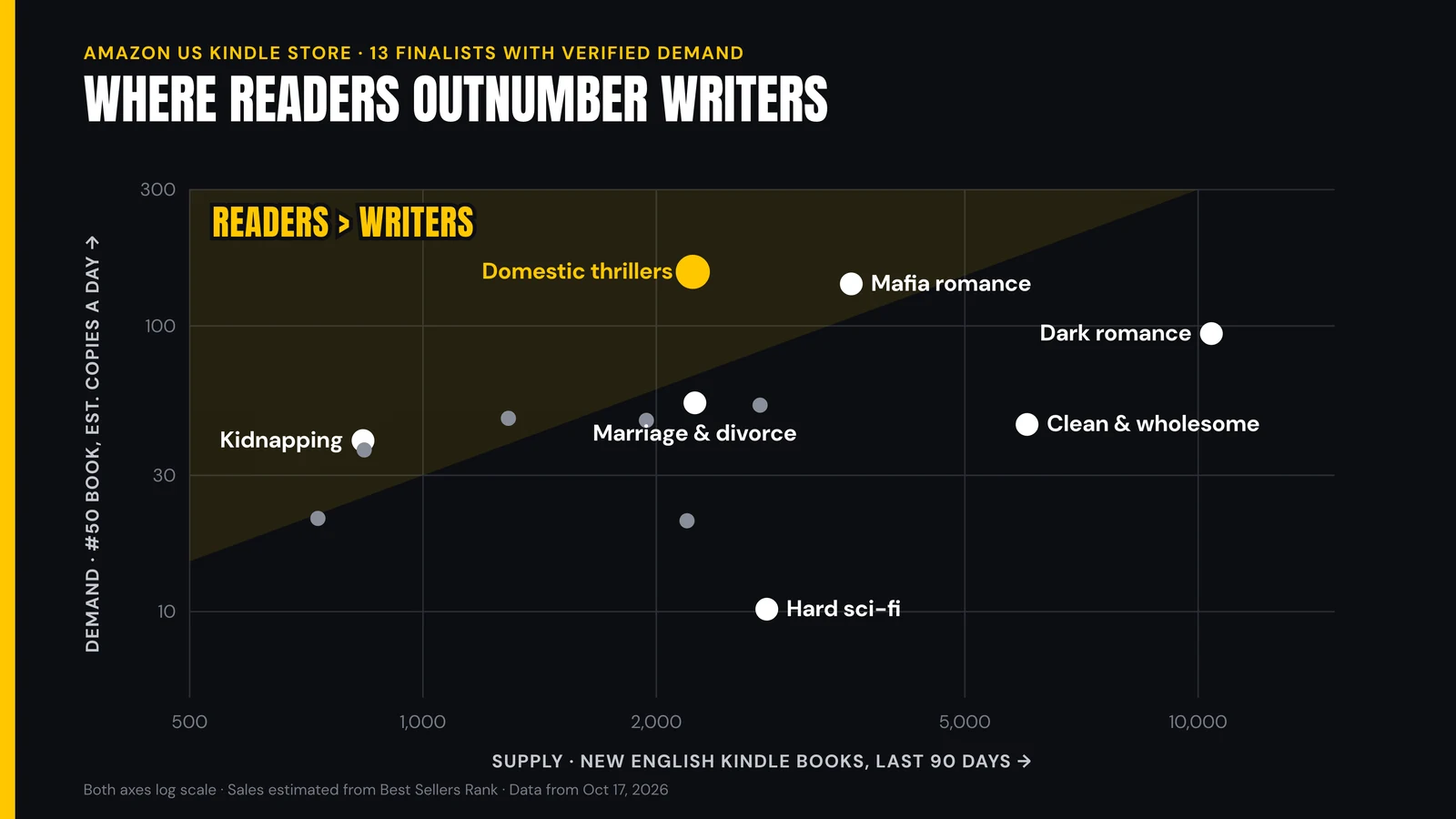
To rank the categories we used one comparison score: the estimated daily sales of the #50 book for every 1,000 new English books in 90 days. It is a way to compare categories on the same day, not a forecast. Here are all 13, from most room to least:
Domestic thrillers: about 2,200 new books in 90 days; the #50 book sells an estimated 155 a day.
Kidnapping crime fiction: about 840 new books; an estimated 40 a day.
Women's crime fiction: about 840 new books; an estimated 37 a day.
Mafia romance: about 3,600 new books; an estimated 140 a day.
Serial killer crime fiction: about 1,300 new books; an estimated 48 a day.
Legal thrillers: about 730 new books; an estimated 21 a day.
Gothic romance: about 1,900 new books; an estimated 47 a day.
Marriage and divorce fiction: about 2,200 new books; an estimated 54 a day.
GameLit and LitRPG: about 2,700 new books; an estimated 53 a day (fewer confirmed ranks, so a rougher estimate).
Cozy fantasy: about 2,200 new books; an estimated 21 a day.
Dark romance: about 10,400 new books; an estimated 95 a day.
Clean and wholesome romance: about 6,000 new books; an estimated 45 a day.
Hard science fiction: about 2,800 new books; an estimated 10 a day.
A good score is where you start looking, not where you stop. The first genre on the list shows why.
Domestic thrillers: the best ratio, held by one author
On paper, domestic thrillers were the most underserved category we measured. The #50 book sells an estimated 155 copies a day, and only about 2,200 new English books came out in 90 days.
Then you look at who is on top. The #1 domestic thriller, Freida McFadden's The Witch, was also #1 in the entire Kindle store. Of the seven top-100 books we could confirm, six were hers.
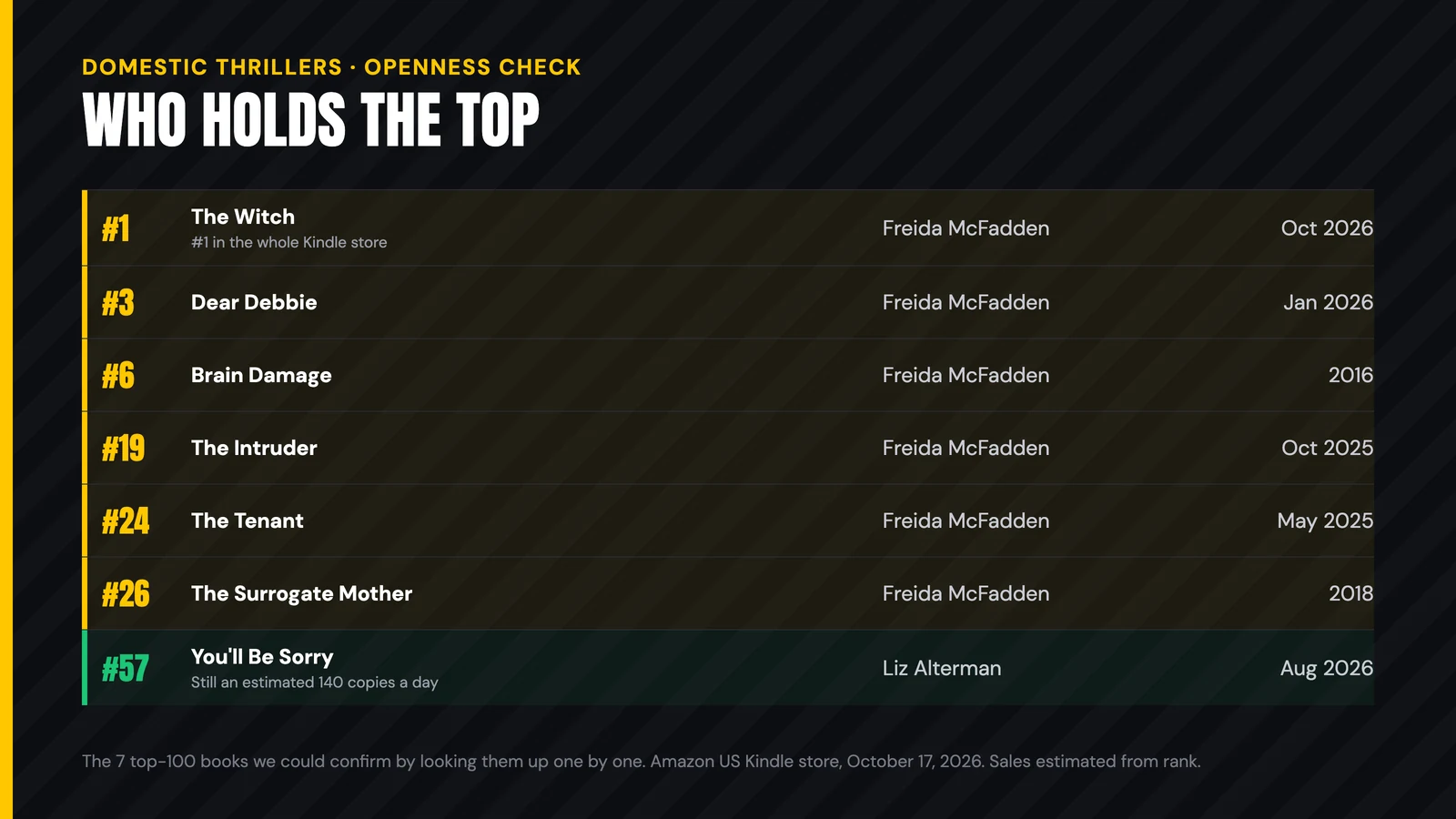
That does not make the category closed. The one confirmed book that was not hers, around #57, still sells an estimated 140 copies a day. But it does mean the ratio flatters the category: a large share of that demand belongs to one author's readers. Before you trust a good number, look at who holds the top ten.
Horror: agents want it, and self-publishers already write plenty
On QueryTracker's lists, horror ranked fifth among the genres agents requested, and it was not in the top ten of what writers on the site were querying. The natural conclusion is that agents want horror and few writers are writing it.
That may be true of writers querying agents. It is not true on Amazon. About 16,400 new English-language horror ebooks came out in 90 days, roughly 180 a day. In Monsters and Creatures horror, one in three of all the books listed in the category came out in those 90 days.
To be fair, that does not prove horror is a bad bet. We could not get a clean demand number for horror as a whole, so this is a supply-only finding. But "nobody is writing it" does not survive the count.
Romance: clean and wholesome is crowded, dark romance is flooded
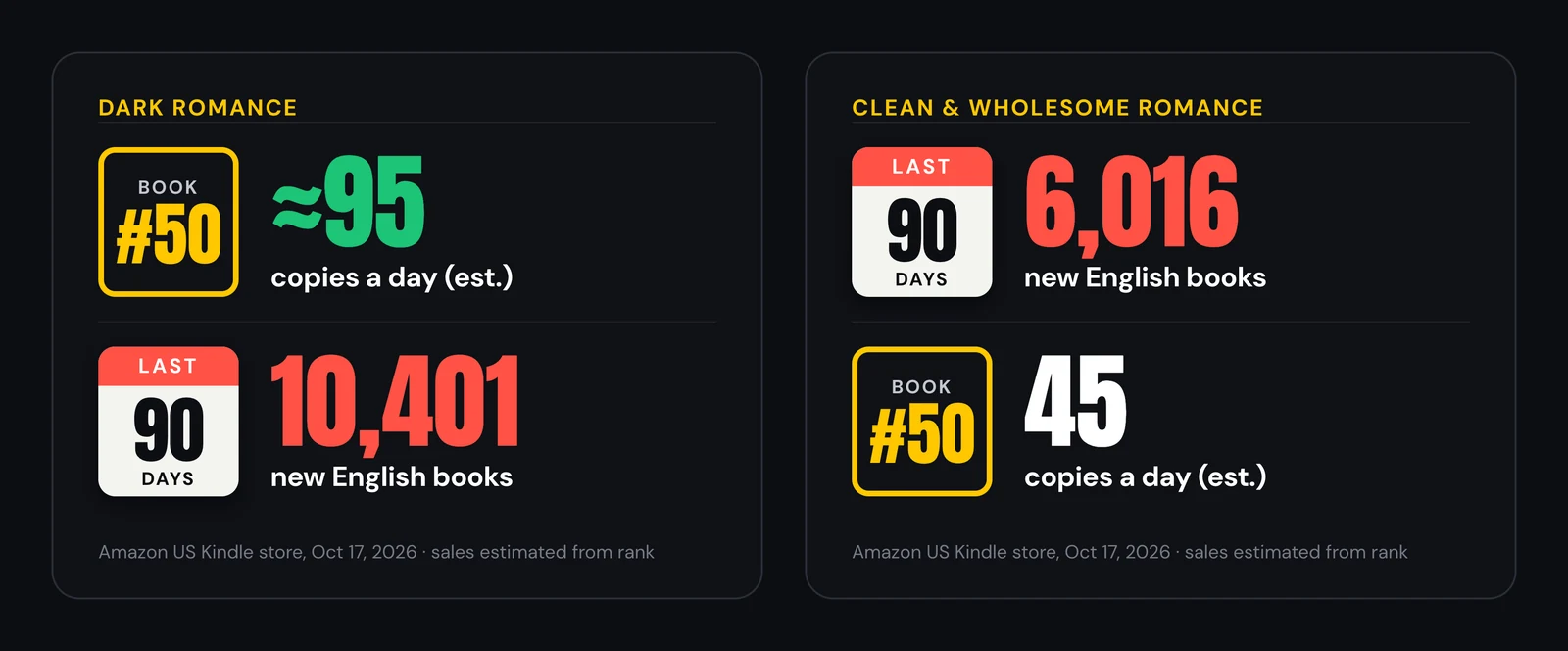
One popular genre ranking called clean and wholesome romance an underserved market. The data says crowded: about 6,000 new English books in 90 days, with the #50 book selling an estimated 45 copies a day.
Dark romance has the same problem from the other direction. Demand is strong, with the #50 book at an estimated 95 copies a day, but more than 10,000 new books arrived in 90 days. Readers love it, and so does everyone publishing into it.
Mafia romance: readers buy what is new
Compare those with mafia romance. The #50 book sells an estimated 140 copies a day, about three times clean romance, and there were about 3,600 new books in 90 days, a little over half as many as clean romance and about a third as many as dark romance.
One detail shows how strong the top of this chart is. The same book, Married to the Devil, ranked #21 in dark romance and #32 in mafia romance. More books outsell it in the smaller category.
Then look at the dates. We confirmed seven top books between #11 and #50. Every one was indie, with no publisher on the listing, and every one came out in the five months before we checked. Two authors had two books each in the top 50, published a few weeks to a couple of months apart, and most of the titles belong to a series.
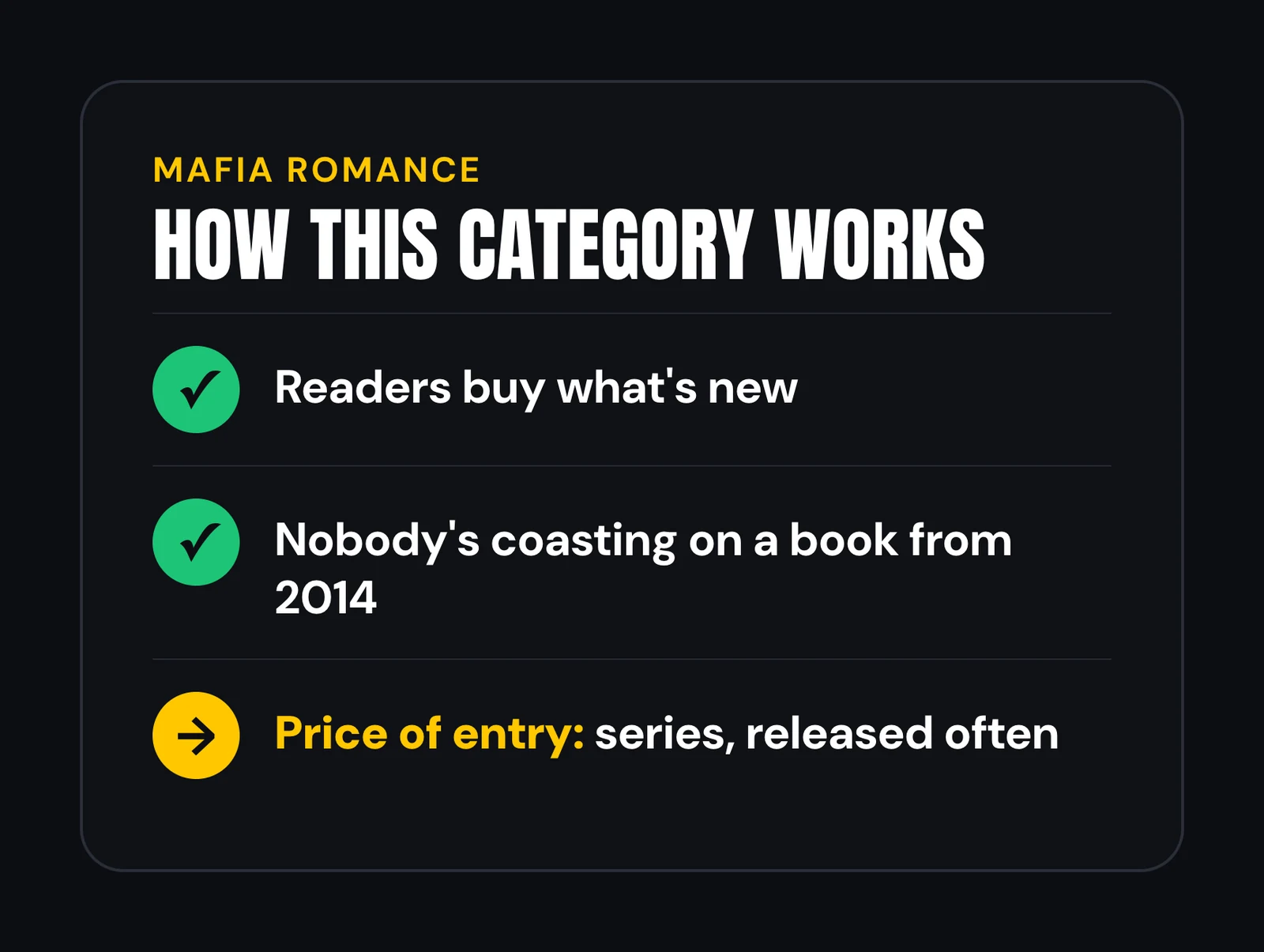
That tells you how this category works. Readers buy what is new, which is good news if you are new, because nobody here is coasting on a book from 2014. The price of entry is speed: a series, released often.
Kidnapping crime fiction: a small category one series can hold
This one is smaller. Kidnapping crime fiction had about 840 new English books in 90 days, and the #50 book sells an estimated 40 copies a day. That is roughly 1,200 copies a month for a book halfway down the top 100.
The top spots we confirmed belong to big publishers, with Karin Slaughter's Pretty Girls at #1. Below them, one indie author, A.J. Rivers, held five of the 12 spots we could confirm in the top 100, across two series: a detective series and an FBI series. Another indie FBI series shows up in there too.
When supply is this small, one author with a couple of series can hold a real piece of the chart. That is what an opening looks like when it is small.
Marriage and divorce fiction: a trend while it is happening
This is the one we would watch most closely. In marriage and divorce fiction, the top two books are from Lake Union, one of Amazon's own publishing imprints. At #5 there was an indie book called The Wife He Chose to Hide, whose subtitle starts "A Marriage in Crisis". It came out at the end of August.
Keep going and you find more. Of the 15 top-100 books we could confirm, five had "Marriage in Crisis" right in the subtitle, and all five came out after the start of July.
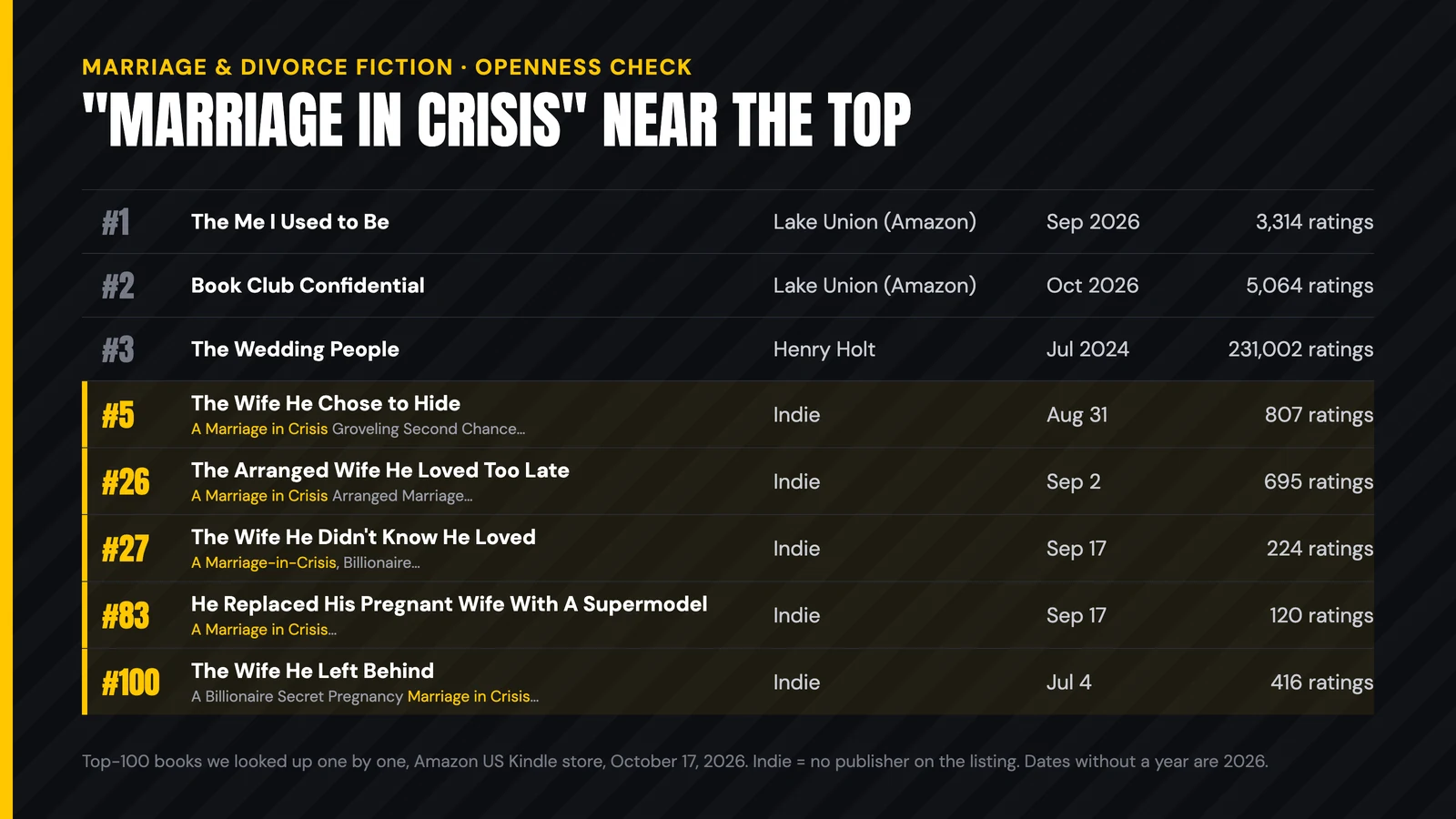
Here is why that matters. The book at #5 had about 800 ratings. The Wedding People, two spots above it, had more than 200,000. On the day we checked, #5's store rank worked out to an estimated 390 copies a day. New, few ratings, high rank: that combination is what an underserved corner looks like while it is still happening.
It will not stay that way. Trends like this fill up. But the pattern is the useful part, and you can look for it in any category.
Hard science fiction: wanted, but readers buy the classics
One more, because it is the opposite case. Readers say they want more hard science fiction, and they do. But look at what they buy: Red Rising, Andy Weir, Arthur C. Clarke, Cixin Liu. Among the top books we confirmed, the median one was almost eight years old, and the #50 book sells an estimated 10 copies a day.
A couple of new indie books are in there, so the category is not closed. It is small, and most of the money goes to books readers already know.
Where new books are arriving fastest
The supply count also shows which categories are filling up quickest. Among categories where Amazon's listed count was not capped, the share of every listed book that came out in the last 90 days was highest in androids, robots and AI science fiction (37%), cozy fantasy (36%), monsters and creatures horror (33%), cosmic and eldritch horror (32%) and second chance romance (32%). At the slow end were Tudor romance (3%) and Viking romance (6%).
A fast-filling category is not automatically a bad one. It means readers there see a lot of new books, so yours needs a reason to be picked.
How to check your own genre in about 10 minutes
You do not need our spreadsheet. Four checks give you the same three numbers for any category.
Find your exact categories. Paste your book's description into our free Category Finder, or look at the categories listed on the books yours would sit next to.
Measure demand. Open the best sellers list for that category. Click the books at #20 and #50, note each one's Kindle Store rank, and put both into the Book Sales Calculator. Now you know roughly what a reachable spot sells.
Measure supply. Search the Kindle store and narrow it to that category. On the left, choose "Last 90 days" under new releases and "English" under language. The result count at the top is your supply.
Check openness. Look at the top 20. Check the publication dates, the publishers and the authors' names. If they are all old, all from big publishers, or one name keeps showing up, readers are not really shopping for someone new.
Doing this on a lot of categories? Book Scout, our free Chrome extension, adds rank, estimated sales and estimated revenue to every Amazon search result, so steps 2 and 4 take a glance instead of a calculator.
Do this inside the genre you actually want to write. We are not suggesting you switch from fantasy to mafia romance. Within the genre you love, there is usually a subgenre where these numbers line up better than the rest.
The limits of this data
The sales numbers are estimates. They come from Best Sellers Rank through our calculator, not from Amazon. Use them to compare categories, not to forecast your own income.
It is a snapshot. Everything here was pulled on October 17, 2026, and ranks move every day.
Competition is not automatically bad. A category with no new books might just be a category with no new readers.
If you take one thing away, do not decide a genre is open because agents want it or because a list calls it underserved. Check the readers, check the new books, and check who is sitting at the top.
FAQ
What is the best genre to self-publish on Amazon?
There is no single best genre. In our October 2026 data, mafia romance, kidnapping crime fiction and "marriage in crisis" books in marriage and divorce fiction had more reader demand than new books arriving. The best genre for you is the subgenre inside the genre you want to write where demand, new-book supply and the top of the chart line up.
Which book genres make the most money on Kindle?
Romance and thrillers showed the strongest demand in our data. The #50 book sold an estimated 155 copies a day in domestic thrillers, 140 in mafia romance and 95 in dark romance. But those genres also draw the most new books, so what one author earns depends on competition and how often they release, not on the genre alone.
How do you find a hungry genre on Amazon?
Compare three things for each category: what the #50 book sells (convert its rank with a sales calculator), how many new English books came out in the last 90 days (Amazon's new-release and language filters), and who holds the top 20. A hungry genre has strong demand, modest supply, and recent books from more than one author near the top.
What does "underserved" mean in this analysis?
It means readers are buying more than new books are arriving. Our comparison score is the estimated daily sales of the #50 book for every 1,000 new English books published in the category in 90 days. It is a way to compare categories on the same day, not a prediction of what a new book will sell.
Why use the #50 book instead of #1?
The #1 book is often a single breakout or a famous author, so it tells you about that book. The #50 book is a spot a newer author can realistically reach, so its sales say more about the category as a whole.
How accurate are sales estimates from Best Sellers Rank?
Amazon does not publish sales figures, so every rank-to-sales number is an estimate. They are useful for comparing categories on the same day and for a rough sense of scale. Ranks also change daily, so a single reading can be off for any one book.
Should I switch genres to follow this data?
We would not. These numbers move daily, trends like "marriage in crisis" fill up, and a series takes a long time to write. Use the method inside the genre you already want to write to find the subgenre with the most room.
More from the blog
Can Amazon Detect AI in Your Book? What KDP Actually Checks
Amazon has not published any AI detection for KDP books. What it does ask, why detectors misfire, what we found running the same texts through four of them, what AI watermarks can and cannot show, and how authors have actually been caught.
10 min readReadKDP AI Disclosure: What to Declare in 5 Common Cases
Amazon's AI question turns on who created the content, not which app you opened. Five common workflows (editing AI text, AI editing your text, brainstorming, AI covers and AI translation) checked against KDP's own definitions.
8 min readReadKDP Trim Sizes: How to Choose the Right Book Size
Every Amazon KDP trim size in inches and centimeters, which size fits which kind of book, and how trim size changes your page count, printing cost, and royalties.
6 min readRead